
Final Attachment — Notes From Director
_[Final Attachment](https://maryamhashempour.com/portfolio/final-attachment/)_ is an autofiction performance by Iranian theatre-maker **Maryam Hashempour**, born from a digital collaboration among Iranian diaspora artists working across Sweden, Iran, Canada, and Germany. Produced by the [Malmö Theatre Academy](https://www.thm.lu.se/en/calendar/maryam-hashempour-final-attachment) as Maryam’s graduation piece, the project took shape after a residency at **[Kontrar Theater](https://kontrar.se/en/show/final-attachment-2/)** (Stockholm) and was later staged in Malmö. Designed as a participatory experience inside a black box, the work asks audiences to move through a personal history where the acts of **seeing** and **being seen** become a lens on state violence, displacement, and the ordinary paperwork that governs extraordinary lives.

Why this project mattered to me
This was the first time I served as a dramaturg for someone performing their own personal narrative. That responsibility was both exhilarating and complex: I had to help shape the piece while protecting the integrity of Maryam’s story, its textures, hesitations, and the lived realities that can’t be smoothed out without losing truth.
From our earliest sessions we talked about her life as an immigrant in Malmö: the distances she carries, the rooms she waits in, the ways institutions decide who can stay, study, or move. Very quickly we were drawn to a dramaturgical frame that was **half-documented, half-imagined**, a staging that could hold visa applications, emails, and appointments alongside memory, dread, and desire. The aim wasn’t to reenact bureaucracy, but to **translate its feeling**: the dryness of forms, the temperature of an office, the way a stamp can sound like a verdict.

Working at a distance
I was in Canada while Maryam was in Sweden, and the time-zone divide shaped our process. We traded drafts, voice notes, photos of objects, layout sketches for the black box, and tiny “micro-scores” for moments we wanted to test. That slow, distributed making became part of the piece’s DNA. The distance wasn’t just logistical; it mirrored the very conditions the work examines, how borders, delays, and documents orchestrate our movement and our time.
Micro-theatre and the politics of the small
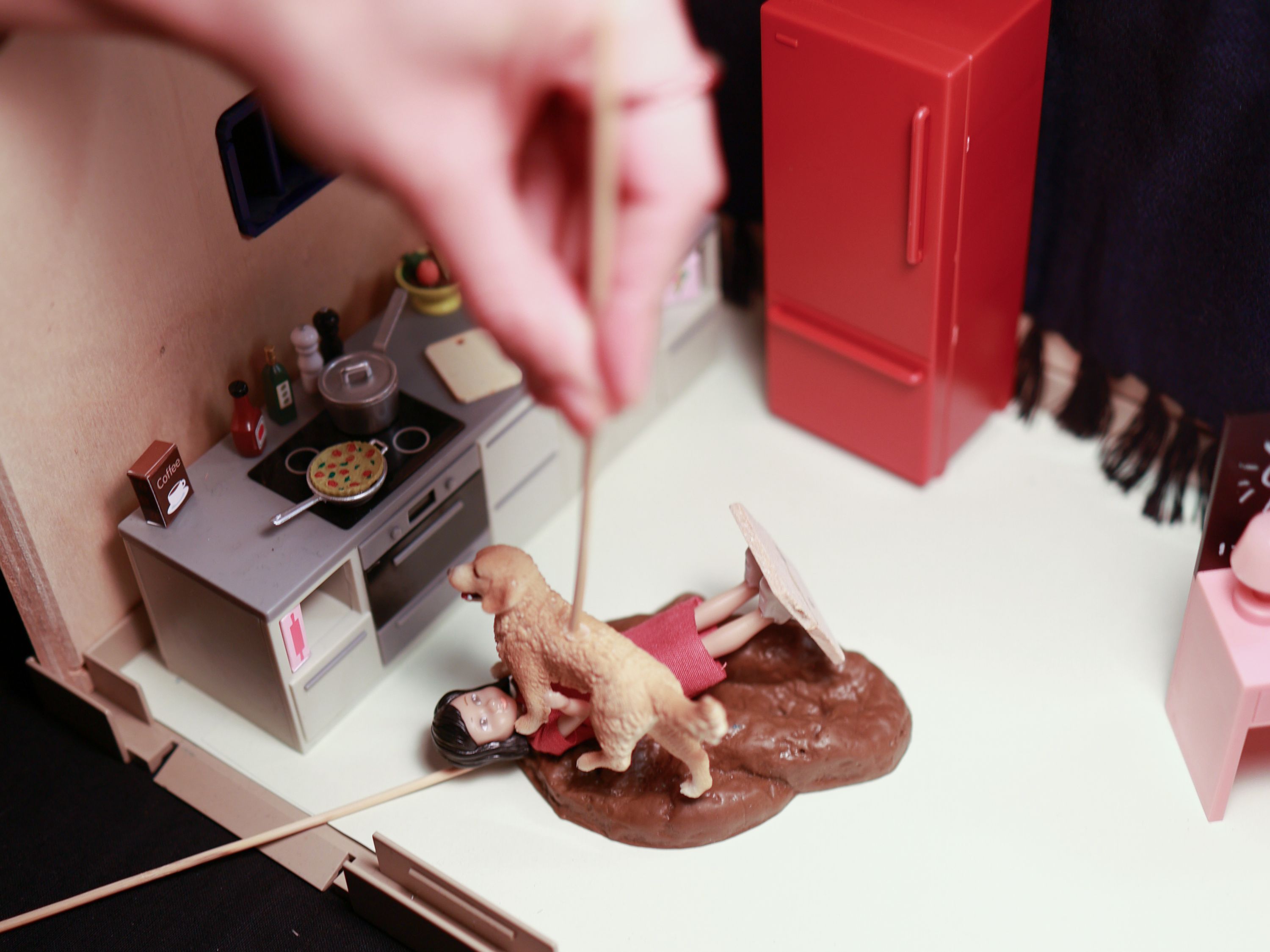
We leaned into **micro-theatre**: compact scenes built from everyday materials—forms, folders, phones, a chair that is always almost a waiting room. Smallness let us stay close to Maryam’s lived detail and invited the audience to become witnesses at an intimate scale. In this proximity, the bureaucratic becomes bodily: your breath in a quiet office, your pulse while a clerk reads your file, the subtle choreography of eye contact that determines whether you are recognized or refused.

Seeing / Being seen
Inside the black box, we tried to make “seeing” and “being seen” tangible. When do we want to be visible, and when does visibility endanger us? We asked the audience to navigate those questions with Maryam, to look without consuming, to witness without extracting. The piece uses participation carefully, with consent at its core, so that spectators can feel the gravity of attention and the ethics of presence as they were our second witness.
Sweden as context, diaspora as method
Although the project was made in Sweden and reflects on **bureaucratic violence** there, it resonates across diasporic contexts. We were a team stretched across borders; that multiplicity kept the work honest.
What we made together
_Final Attachment_ doesn’t try to resolve a system. Instead, it **stages an encounter**: Maryam’s voice, the audience’s gaze, the room’s rules, and the quiet insistence of documents that claim authority over a life. The result is a mosaic of fragments, some verified, some unverifiable, that, together, feel true.
We built it piece by piece, at odd hours, across screens and cities. And then Maryam stepped into the room, first at **Kontrar Theater** in Stockholm, and later in Malmö, to perform it live. Watching the work breathe with audiences confirmed what we’d hoped: that small, careful theatre can hold big, difficult realities.
* * *
**Credits**
Created and performed by Maryam Hashempour
Dramaturg: Syd Hamidreza Hosseini
Produced by Malmö Theatre Academy
Performers: Maryam Hashempour, Tahmasb Mahdavi
Sound designers: Deniz Tafaghodi, Farbod Maeen
Visual artist: Amirhossein Zarifian
Scenographer: Arduino Punzo
Advisors: Nassim Soleimanpour, Sophia New
Special thanks to: Edit Kaldor, Keyvan Sarreshteh, Nassim Aghili, Eva Hedblom, Ranin Souliman, Henrik Lagergren, Linda Blom, Behnam Sadighi
Developed following a residency at Kontrar Theater (Stockholm)
Presented in Stockholm and Malmö
Date: April 2025